
Share this post!
Commercial property management in Toronto is not residential management with bigger tenants. The two jobs run on different statutes, they end up in different forums when something goes wrong, they carry different tax treatment, and they place the duty to fund major repairs in different hands. That holds whether you own office, industrial or retail space, or you sit as a director on the board of a commercial or mixed-use condominium corporation. Before anything else, settle one question: is the asset a condominium corporation, or a privately owned building?
That single answer decides the rulebook, the licence your manager needs, who has to fund the roof and what you file every year. The property management company you have today may be very good at the work it was hired to do, and still be built around a different kind of building.
Two Statutes, Two Forums: Which One Governs Your Tenancy
Your tenant’s lease is governed by one of two Ontario statutes, and which one applies is decided by what the tenancy is, not by what the document is called. That choice is not academic. It decides the remedy you have when rent stops arriving, the notice you owe before you act, and the forum where the argument gets settled.
The Statute Follows the Tenancy, Not the Title on the Lease
Ontario’s Commercial Tenancies Act does not apply to tenancies the Residential Tenancies Act, 2006 applies to, and the residential statute applies with respect to rental units in residential complexes, despite any agreement to the contrary. The law sorts your tenancy by what it actually is. The gap between the two shows up first in the paperwork. Ontario requires most residential tenancy agreements signed on or after April 30, 2018 to use a standard lease the Province publishes, with exceptions including care homes and co-operative housing, and the landlord must give the tenant a copy within 21 days of signing. Commercial leasing has no equivalent form, which is why your commercial lease is the operating document, and why a manager who has not read it cannot run the building.
Unpaid Rent: What the Commercial Route Actually Allows
Here is the catch a residential landlord never meets. Your lease is treated as letting you take the space back if rent stays unpaid for 15 days after a day it was due, unless the lease says otherwise. That is quicker than the residential route, and it turns on the wording of your own document. A different route applies to breaches other than non-payment of rent: there the landlord has to serve a notice specifying the particular breach, requiring it to be remedied if it can be remedied, and requiring compensation in money. The arrears route and the other-breach route are not the same route, and treating them as one is how an owner gives up a position they actually had.
Where a Commercial Dispute Is Decided, and What the Tenant Can Still Do
Residential disputes go to the Landlord and Tenant Board, which exists under the residential statute. A commercial lease dispute does not, and a commercial landlord ends up in the Superior Court of Justice instead. A tenant facing the end of the lease can apply to that court and ask a judge to stop it, and the judge decides what is fair in the circumstances. Fast is not the same as final.
Where a tenant will not leave after the lease has ended, the landlord applies to a judge of that court, in the county or district where the building is. A commercial dispute goes to a court rather than a tribunal, which is why arrears have to reach the owner early rather than at the point of default.
The Question That Routes Everything Else: Corporation or Privately Owned Building

Your building is either a condominium corporation or it is privately owned, and that one fact decides which rulebook you are under, which licence your manager needs, who has to fund major repairs and what you file every year. You probably already know which one you have. Settle it first anyway, because condominium management services and the management of a privately owned building are two different engagements with two different accountability structures.
A Commercial Condominium Corporation Is a Condominium Corporation
A commercial or mixed-use condominium corporation is a condominium corporation. The Condominium Act attaches to the corporation, not to what the units are used for, so the duties are the same ones a residential board carries. The licensing law uses the same definition, and it does not care what the units are used for either. Here is the catch: boards of commercial corporations often assume the condominium rules are a residential thing. They are not, and the assumption usually surfaces at the worst possible moment, which is the first serious arrears question or the first time a lender asks for a certificate.
The Same Filings, Certificates and Clocks Apply to Your Corporation
The filing calendar is the same calendar. Your corporation files an annual return with the Condominium Authority of Ontario between January 1 and March 31, and a turn-over return within 90 days of a turn-over meeting. Those are two different returns on two different clocks, and they never collapse into one deadline. Periodic Information Certificates go to all owners twice per fiscal year, within 60 days of the end of the first and third quarters. An Information Certificate Update must go out within 30 days of a change, for example a change in the directors or officers.
Your corporation has 10 days to produce a condo status certificate, and it can charge no more than $100 including all applicable taxes for it. The certificate comes from the corporation, not from the manager personally, and anyone can request one. Your corporation also has to respond to a Request for Records within 30 days, using the response form the Province prescribes, and disputes about records, pets, vehicles, parking and nuisances go to the Condominium Authority Tribunal whether the units are offices or apartments.
A buyer’s or a lender’s request starts that 10 day clock even though a commercial corporation’s financial picture can take longer than that to assemble. None of these clocks pause because the directors are running their own businesses. A board that meets quarterly cannot absorb a 10 day or a 30 day obligation by waiting for the next meeting. After 15 years on GTA condominium properties we treat certificate packages, returns and certificate distributions as standing work with dates attached rather than as requests that arrive and get triaged.
Mixed-Use Buildings: Which Rulebook Applies Can Change Space by Space
In a mixed-use building the answer is not one answer. Which statute governs a given space turns on how the premises are occupied and how the lease is written, so get that settled space by space before you assume the building has a single rulebook. The practical consequence is sharper than the legal one. In a building with shops at grade and apartments above, the garage, the roof and the budget are shared, while the rules over the spaces underneath them are not. That is where the friction sits: one cost-sharing arrangement, two sets of occupants who want different things from the same asset.
The Licence Boundary: Where It Reaches Your Asset and Where It Stops

Whether the person managing your building has to hold a licence depends entirely on whether your asset is a condominium corporation. One answer gives you a licence you can check in a public register. The other sends you to the management agreement and to the firm’s own answer in writing.
If It Is a Condominium Corporation, the Licence Applies
Condominium management services means collecting or holding the corporation’s money, or using powers the corporation or its board has handed over. That includes paying third parties, signing contracts and supervising staff or contractors on the corporation’s behalf. The trigger is who the services are provided to or on behalf of: a condominium corporation. So if your corporation is a condominium corporation, the person managing it needs the licence, and it makes no difference that your units are offices or warehouses rather than apartments.
There are two licences here, and two checks. The firm holds a provider licence, the individual holds a manager licence, and a licensed provider may not employ an unlicensed person to do work that requires a licence. The provincial regulator keeps a public register of licensed condominium managers and management providers, which makes this one of the few things about a management arrangement you can confirm from outside it. Looking an entry up in that register and reading what the CMRAO licence classes allow is a short job for a director, and it is the piece of due diligence a board can finish without anyone’s permission.
If It Is Your Own Building, That Licence Does Not Reach It
Managing a privately owned office or industrial building for its owner is a different thing. It is not condominium management, so that licence does not reach it. Commercial condominium management is a licensed activity in Ontario. Managing a privately owned office or industrial building is not the same activity and is not covered by that licence, which does not mean nothing applies to it. Ask any firm you are considering which registrations and licences it actually holds, and for what, and get the answer in writing.
The management agreement is where you set what your manager may commit you to. Its spending limits, its reporting obligations and its termination terms are worth reading before you sign rather than after a surprise invoice, and the registrations question above is the other half of the same answer.
Who Has to Fund the Roof: A Statutory Duty on One Side, Your Own Plan on the Other

If your units sit in a condominium corporation, the law makes you set money aside for major repairs. If you own the building outright, no statute makes you set aside anything, so the timing is your own decision. The roof costs the same either way.
What a Commercial Condominium Corporation Must Hold and Study
Your corporation has to hold a reserve fund for major repairs and replacements of the common elements and assets, it cannot spend that fund on improvements, and the study behind it gets updated on a three-year cycle. The first comprehensive study is tied to the registration of the corporation. The Condominium Authority of Ontario states the improvement limit plainly, and it is the point commercial boards ask about constantly. You cannot spend the reserve on an improvement, which is why the upgrade the tenants want and the roof the building needs come out of two different places. Budget them as two different things, because that is what they are.
Why a Privately Owned Building’s Capital Plan Is Entirely Yours
A privately owned office or industrial building has no statutory reserve fund and no required study behind it. Nobody makes an owner fund the roof. That is the owner’s own plan, or it is nothing, and the cost of not having one shows up as a capital call you did not choose the timing of.
A plan worth the name carries four things: a condition assessment of the building’s major components, an expected remaining life for each, an order of operations, and a funding source identified before the component fails. On an income property that is not housekeeping. Deferred work shows up in what a lender will advance and what a buyer will pay, because the asset is valued on its income. Sequencing that work, pricing it and running it is capital project management, and it belongs in a plan rather than in a scramble.
How the Money Works Differently, Starting With Tax on Rent

The rent your commercial tenant pays, the tax that goes on top of it and the costs you can bill back all work differently from a residential tenancy. The through-line is simple. On the residential side the statute sets the terms. On the commercial side the lease does, and the tax follows the kind of space rather than the size of the cheque.
HST on Commercial Rent, and the Residential Exemption It Does Not Share
HST applies to commercial rent unless the arrangement is specifically exempted, and in Ontario the rate is 13 per cent. Long-term residential rent, meaning one month or more, is exempt. Commercial rent is not.
This is a Canada Revenue Agency rule rather than a provincial or municipal one, and the rate is set that way here because Ontario is a participating province. It changes the cash you handle and the registration you need, which is why a commercial rent roll and a residential rent roll are not the same bookkeeping job. One charges and remits tax on every invoice. The other does not.
HST and Commercial Condominium Fees: The Exemption Is Written for Residential Units
The exemption that keeps HST off residential condo fees is written for a residential condominium unit. If your units are commercial, that exemption is not the one you are standing on, so the tax treatment of your common expense contributions is a question for your accountant before you set the budget. The consequence lands in the budget. A board that sets next year’s common expense contributions without settling this question first has budgeted a number it may not be able to rely on. The time to settle it is before the budget goes to owners, not after.
On the Commercial Side, Recoveries Live in the Lease
There is no statute that tells you how operating costs and property taxes get recovered from a commercial tenant. Your lease does. That is why a commercial manager reads the lease before the budget. The lease defines additional rent, and common area maintenance is one part of it.
The residential contrast is a published number. Ontario’s rent increase guideline for 2027 is 1.9 per cent for most units, and the guideline does not apply to commercial properties at all. It also does not reach units first occupied for residential purposes after November 15, 2018, and a residential increase needs at least 90 days written notice. On the commercial side, the escalation is whatever your lease says it is.
Cost recovery is where commercial management goes wrong, and it stays invisible until the year-end reconciliation is challenged. The cycle is steady work: budget, estimate, bill monthly, reconcile at year end, and be able to defend the reconciliation line by line. A manager who cannot do the last step has not really done the first four.
Toronto Property Tax: The Class Your Building Sits In Changes the Bill
Your Toronto tax bill is set by the property class your building is assessed in, and the commercial and industrial classes carry the city’s highest rates. These are Toronto rates. Markham, Mississauga, Oakville and every other municipality in the region set their own, so a portfolio spread across the region sits under several rate tables at once.
Toronto’s 2026 Rates by Property Class
Toronto’s 2026 commercial total rate is 2.301986 per cent of assessed value, against 0.767311 per cent residential. Industrial sits at 2.416774 per cent of assessed value for 2026, and multi-residential at 1.208792 per cent. Property class in this sense is an assessment and taxation classification, not the Building Code’s occupancy classification, and your assessment is what decides the rate. On a commercial asset the tax line is usually recoverable from tenants under the lease, so the rate drives the gross occupancy cost a tenant is quoted, and therefore what the space can actually be leased for.
The Toronto Small Business Subclass: 20 Per Cent Off the Municipal Portion
Through its 2026 budget Toronto raised the Small Business Property Tax Subclass discount from 15 to 20 per cent of the municipal portion of commercial property taxes, and the City says about 63 per cent of Toronto’s commercial properties qualify. The province matches on the education portion. The subclass was first adopted in 2021 and came into effect in 2022. This is relief a small commercial owner or a retail condominium board may be eligible for and is not claiming, and it exists on one side of the comparison only. Take your own assessment to the City and ask, rather than assuming either way.
Commercial and Residential Side by Side
A commercial condominium board has to fund major repairs by law. A commercial building owner does not, so the timing of that spending is theirs to decide. Which of the two regimes your asset sits in decides the rulebook, the licence and who has to fund the roof. What the building measures, contains and employs decides the compliance calendar.
| What it is | Commercial | Residential |
| Governing statute | Commercial Tenancies Act, which does not apply to tenancies the Residential Tenancies Act, 2006 applies to | Residential Tenancies Act, 2006, which applies to rental units in residential complexes despite any agreement to the contrary |
| Where a dispute goes | The Superior Court of Justice, including a landlord’s application to remove a tenant who will not leave, and a tenant’s application asking a judge to stop the lease being ended | The Landlord and Tenant Board, the tribunal created under the residential statute |
| Non-payment of rent | A lease is treated as letting the landlord take the space back if rent stays unpaid for 15 days after a day it was due, unless the lease says otherwise | Governed by the residential statute and decided by the Board, not by the landlord |
| Rent increases | No provincial guideline applies to commercial properties | Ontario’s guideline for 2027 is 1.9 per cent for most units, with 90 days written notice, and it does not apply to units first occupied for residential purposes after November 15, 2018 |
| The written agreement | No prescribed form, so the lease is the operating document | Ontario’s standard lease is required for most tenancy agreements signed on or after April 30, 2018, with exceptions including care homes and co-operative housing |
| HST on rent | HST applies to commercial rent unless the arrangement is specifically exempted, and Ontario’s rate is 13 per cent | Long-term rentals of residential accommodation, meaning one month or more, are exempt |
| HST on condominium fees | The exemption is written for a residential condominium unit, so a commercial unit does not sit inside it | Residential condominium fees are listed by the CRA as an exempt supply |
| Toronto property tax, 2026 | Commercial total rate 2.301986 per cent of assessed value; industrial 2.416774 per cent | Residential total rate 0.767311 per cent of assessed value; multi-residential 1.208792 per cent |
| Toronto small business tax subclass | Raised through the City’s 2026 budget to 20 per cent of the municipal portion of commercial property taxes, with about 63 per cent of Toronto commercial properties eligible | No equivalent subclass |
| Capital funding duty | A commercial condominium corporation must collect a reserve fund for major repairs and replacements and update its study on a three-year cycle. There is none by statute for a privately owned building, so the plan is whatever the owner sets | A residential condominium corporation carries the same reserve fund duty. A privately owned rental building has none by statute, so the plan is whatever the owner sets |
What Actually Triggers a Compliance Obligation Is Not the Word Commercial

Almost none of your building’s compliance obligations are triggered by the word commercial. They are triggered by floor area, by occupancy classification, by equipment on site, and by how many people your organization employs. So the better question is not whether your building is commercial. It is what the building measures, what it contains and how many people it employs, and all three are things you can check this afternoon.
Floor Area: Energy and Water Reporting, and Toronto’s 2027 Reporting Year
If you own a building of 50,000 square feet or more anywhere in Ontario, last year’s energy and water use has to be reported to the Province by July 1, unless your building falls into one of the prescribed exemptions. The duty sits on the owner, and it reaches Burlington, Markham, Mississauga, Newmarket, Oakville, Scarborough, Thornhill and Toronto alike.
In Toronto, buildings of 10,000 square feet and up will start reporting energy and water use for the 2027 reporting year, with the report due on the first business day of July. So a 12,000 square foot Toronto retail plaza or small office building is below both thresholds today and becomes a reporting building for the 2027 reporting year. A Toronto building of 50,000 square feet or more reports twice, once to the Province and once to the City, on two deadlines days apart, and the City’s requirement does not carry the ongoing property-use exceptions the provincial one does. Under Toronto’s Chapter 367, a person convicted of a reporting offence is liable to a maximum fine of $100,000 on conviction.
Occupancy: When a Fire Safety Plan Is Required, and Toronto’s Fire Safety Box
Whether your building needs a fire safety plan approved by the Chief Fire Official depends on what the building is and what goes on inside it, and once it does need one, Toronto adds a fire safety box holding a true copy of that approved plan. Get the determination from Toronto Fire Services for your building rather than reasoning from the building next door.
In Toronto, if your building is one that has to have a fire safety plan approved by the Chief Fire Official, it also has to carry a fire safety box with a true copy of that approved plan inside. Under that same Toronto bylaw, a director or officer who knowingly goes along with a breach of that requirement commits an offence of their own. The box holds an unlocked replacement padlock as well, and the owner supplies the Fire Department a full working set of keys to the service rooms.
That director and officer provision is worth reading twice, because it reaches a director personally. For a board of business owners governing in their spare time, that is the sharpest reason to know what the building is required to have and who last confirmed it.
Equipment: Every Elevating Device Carries Its Own Licence
Every elevating device in your building is licensed in its own right, and the duty to keep that licence current and the maintenance done by a registered contractor sits with the owner of the device. A building with freight elevators, a passenger bank and a lift has several of those obligations running at once, not one. The interval between maintenance visits is not a fixed number either: it is set from the manufacturer’s specifications and from the device’s quality, age and frequency of use. This is an equipment-triggered duty rather than a commercial-versus-residential difference, and the obligation multiplies with what the building contains, not with its square footage.
Headcount: Accessibility Duties Are Sized by Employees, Not by Buildings
Accessibility obligations in Ontario are sized by how many people the organization employs, not by what kind of building it owns, and the compliance report for an organization with 20 or more employees is due December 31, 2026. Count your own employees before you assume it is someone else’s problem. The duties scale with headcount, and an organization with 50 or more carries more of them.
The Toronto Market Your Building Sits In
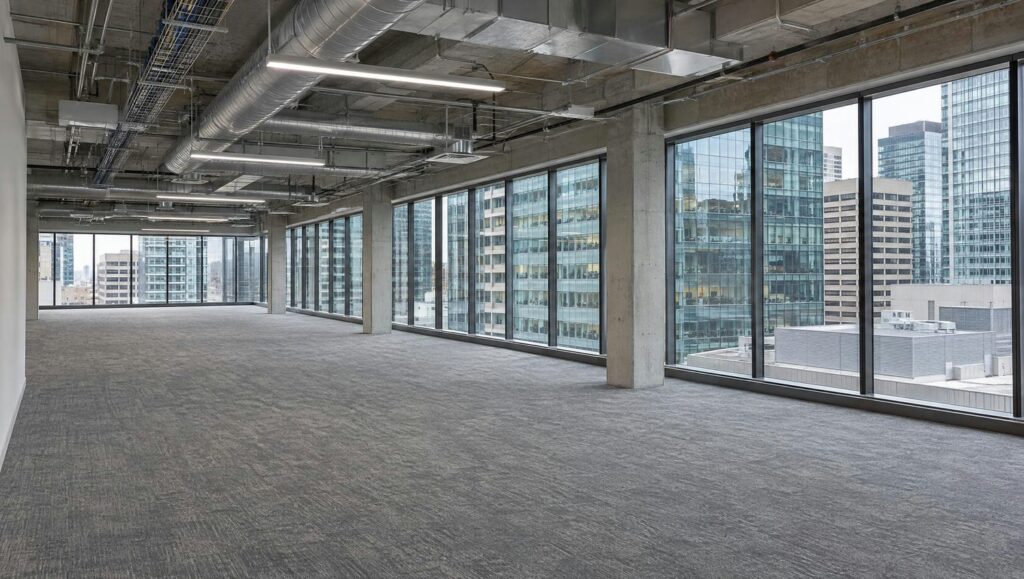
Altus Group put Toronto’s office availability rate at 15.1 per cent in the third quarter of 2026, and industrial availability at 5.3 per cent. Class A availability in the Financial District was 9.2 per cent. Office availability was down 190 basis points year over year, where 100 basis points is one percentage point, while industrial availability was up 60 basis points.
Empty space between tenancies is an operating condition in commercial real estate, not an emergency. It still has to be heated, insured, secured, shown and kept in showable condition, and the cost of carrying it belongs in the budget before it happens rather than after. Nothing like that line appears on a residential budget.
How to Tell Whether Your Commercial Property Management Fits the Asset

You can test the arrangement you have now with a handful of questions, and the answers come back quickly. The questions that matter on a commercial asset are not the ones that matter on a condo tower full of apartments, which is why a firm can serve a residential board well and still be the wrong fit for your plaza.
The Questions That Reveal Whether a Manager Is Built for This Asset
Six questions separate a fit from a mismatch, and none of them takes long to ask.
- Has the person managing this read the lease, and can they tell you who carries which repair obligation under it?
- Can they produce a year-end reconciliation of operating costs and realty taxes that a tenant’s own accountant could check?
- Who are they accountable to on this asset: a board, a single owner, or a shared facilities committee?
- What is on their compliance calendar for this building in the next 12 months, and what triggers each item?
- Who handles a tenant fit-out or a change of use, and what do they do about permits, code classification, insurance and fire and life safety when a tenant alters the space?
- Which registrations and licences does the firm actually hold, for what, and will they put the answer in writing?
Question five does more work than it looks like it does. Tenants keep changing a commercial building: one leaves, another arrives, and each alteration touches permits, code classification, insurance and fire and life safety. A manager who has not read the lease cannot approve a fit-out, which is why commercial management carries a construction and approvals function that residential management mostly does not.
Question two is really about who the reporting is for. A commercial owner’s reporting has to be legible to a lender, an appraiser and a buyer, not only to the owner, because the asset is valued on its income. A report that satisfies a homeowner does not satisfy a refinancing. Question three sounds procedural and is not: we report to a board on a condominium corporation, to a single owner on an office or industrial building, to a shared facilities committee where one exists, and to the membership on a co-op or co-ownership building. The reporting line changes what the job actually is.
What Drives the Cost of Managing a Commercial Property
What it costs to manage a commercial property depends on the size of the building, its systems, its condition and how much time it needs on site. That is why a serious firm quotes it per property and puts the fee and the scope in writing before you sign. On a commercial asset, four further things move the number. Two are structural: how many separate tenancies there are, and what recovery structure their leases set up. Two are workload: how much approvals and fit-out work the building generates, and whether a board and a statutory filing calendar sit on top of it all.
A cheaper version of this work usually gives up the same two pieces: the cost recovery accounting and the capital plan. Both are invisible until they fail, and both are what protect an income property. Hiring on fee alone is the expensive decision to reverse, because you find out a year later that nobody reconciled the operating costs.
What the Right Manager Looks Like for Your Building
Once you know which branch your asset sits in, the useful next conversation is about this building rather than about management in general. CPO Management has spent more than 15 years managing GTA residential and commercial condominium properties, and the portfolio runs across the full property spectrum: office and industrial buildings, co-ops and co-ownership buildings, commercial and mixed-use condominium corporations, and community and recreation centres. Our condominium management is CMRAO-licensed, and we work across Burlington, Markham, Mississauga, Newmarket, Oakville, Scarborough, Thornhill and Toronto. If you want a second read on whether the arrangement you have fits the asset, our property management services team will go through the lease, the management agreement and the compliance calendar with you and tell you what we find. Request a Proposal and we will price it for your property, with the scope in writing.
Frequently Asked Questions
Commercial owners and boards tend to arrive at the same questions, and most of them come back to which of the two regimes the asset sits in.
Yes. A commercial or mixed-use condominium corporation is a condominium corporation, and the Act attaches to the corporation rather than to what the units are used for. So the duties your board carries are the same ones a residential board carries: the reserve fund, the returns, the certificates and the records. Offices, warehouses and retail bays change how the building operates. They do not change the rulebook.
It depends on the asset. If the client is a condominium corporation, the person managing it needs the licence, and it makes no difference that the units are offices or warehouses rather than apartments. Managing a privately owned office or industrial building for its owner is not the same activity and is not covered by that licence, which does not mean nothing applies to it. On that side, what you have is the management agreement and the firm’s written answer on the registrations and licences it holds.
No. That board exists under the residential statute, and a commercial lease dispute ends up in the Superior Court of Justice instead. A landlord’s application to remove a tenant who will not leave after the lease has ended goes to a judge of that court, in the county or district where the building is. The tenant can apply to the same court and ask a judge to stop the lease being ended.
Yes. HST applies to commercial rent unless the arrangement is specifically exempted, and in Ontario the rate is 13 per cent. The contrast is with long-term residential rent, meaning one month or more, which is exempt. This is a Canada Revenue Agency rule rather than a provincial or municipal one, so it reaches your building the same way in Burlington, Markham or Toronto.
Possibly. The City says about 63 per cent of Toronto’s commercial properties are eligible for the Small Business Property Tax Subclass, which through the City’s 2026 budget gives 20 per cent off the municipal portion of commercial property taxes, with the province matching on the education portion. Since it is not every property, the answer for your building comes from the City against your own assessment. It is a Toronto subclass and does not apply elsewhere in the region.
Yes, starting with the 2027 reporting year, with the report due on the first business day of July. That is a Toronto requirement and it reaches buildings of 10,000 square feet and up. The separate provincial duty sits at 50,000 square feet or more anywhere in Ontario, so a 12,000 square foot plaza is outside that one. Put the Toronto date on the calendar now, because the reporting year starts before the report is due.